For many businesses, updating a website is still more complicated than it needs to be.
A new landing page becomes a ticket for IT. A news article waits for a developer. A simple content amendment joins the bottom of an agency's workload.
Over time, those delays discourage regular updates altogether.
A Content Management System (CMS) should remove those barriers, giving businesses the confidence to manage their own website quickly, safely, and without specialist technical knowledge.
Content Should Move at the Speed of Your Business
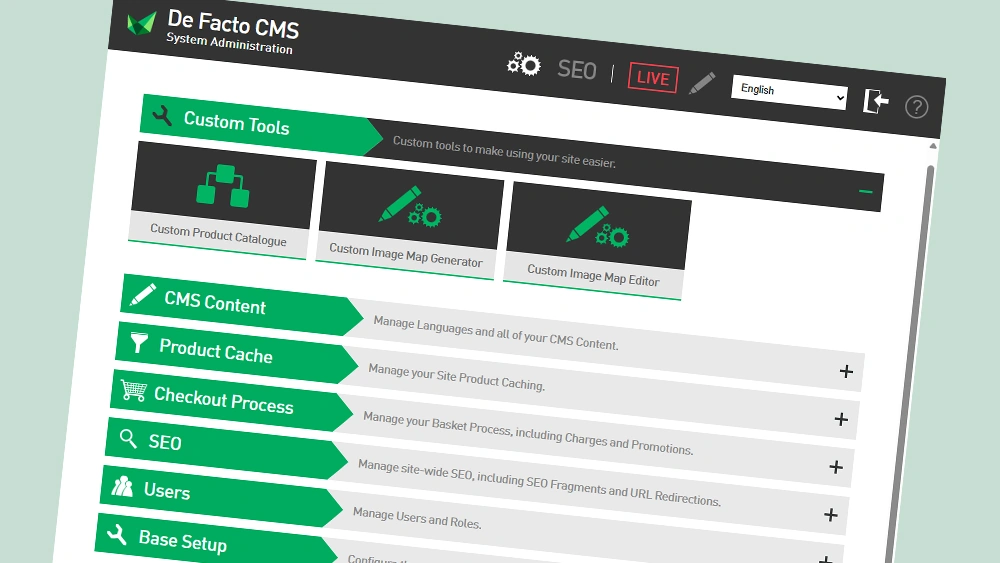
Your website is often the first place customers, suppliers and prospects go for information. Whether it's publishing a case study, creating a campaign landing page, announcing company news or updating an existing page, businesses shouldn't have to wait days - or weeks - for changes to go live.
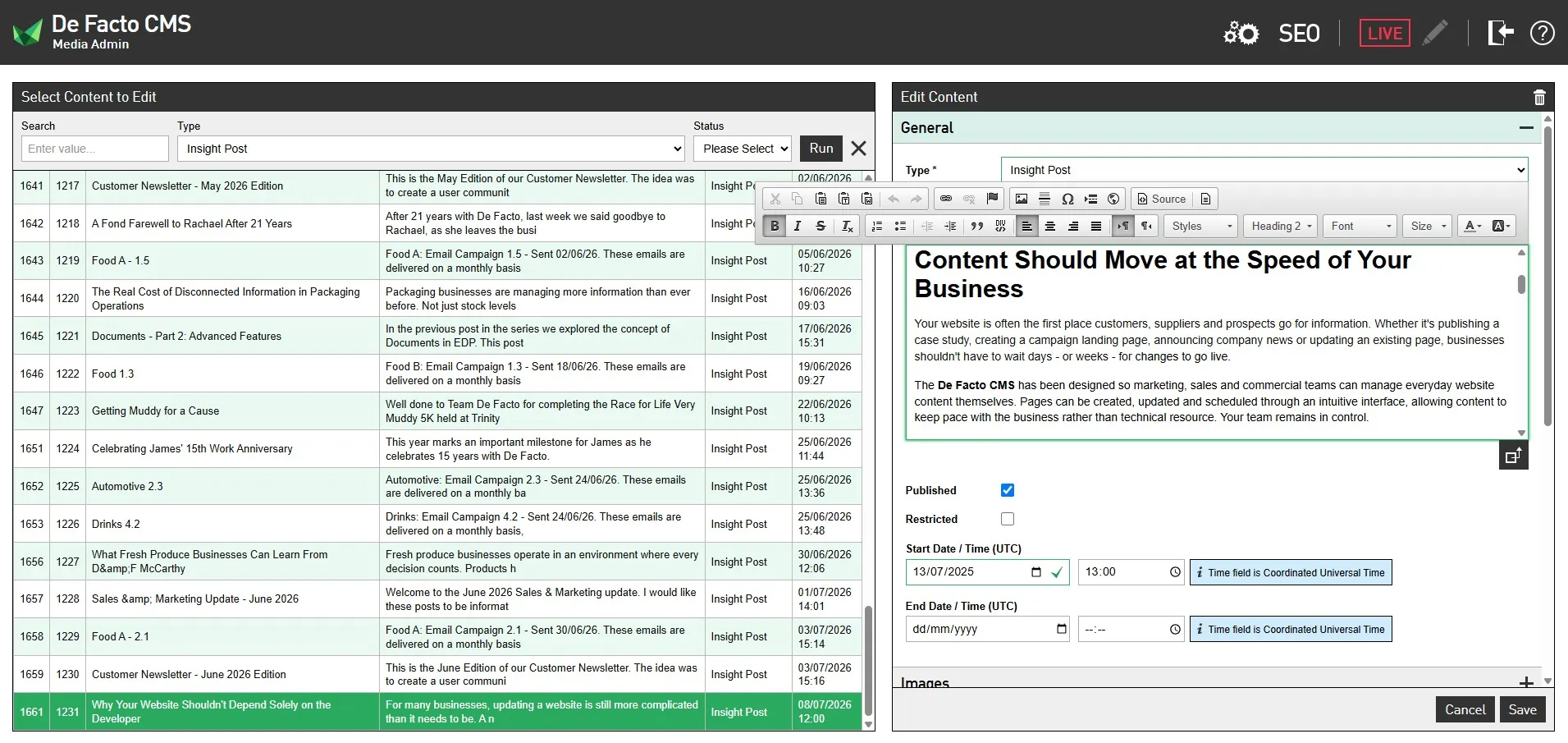
The De Facto CMS has been designed so marketing, sales and commercial teams can manage everyday website content themselves. Pages can be created, updated and scheduled through an intuitive interface, allowing content to keep pace with the business rather than technical resource. Your team remains in control.
Most CMS Platforms Stop at Content. Yours Doesn't Have To.
Often, that's where the role of a CMS ends.
But when your website is connected to the wider business, it can become much more than a publishing tool.
Because the De Facto CMS forms part of our wider ERP and e-commerce solutions, it can support operational processes as well as marketing activity. Secure sites, sub-sites and portals can be created for suppliers, logistics providers or internal teams, allowing the right people to access and update relevant information securely. This reduces complexity, improves consistency, and creates a more user-friendly experience for both administrators and users.
That's not all. The De Facto CMS also provides the flexibility to develop bespoke functionality that enhances the customer experience.
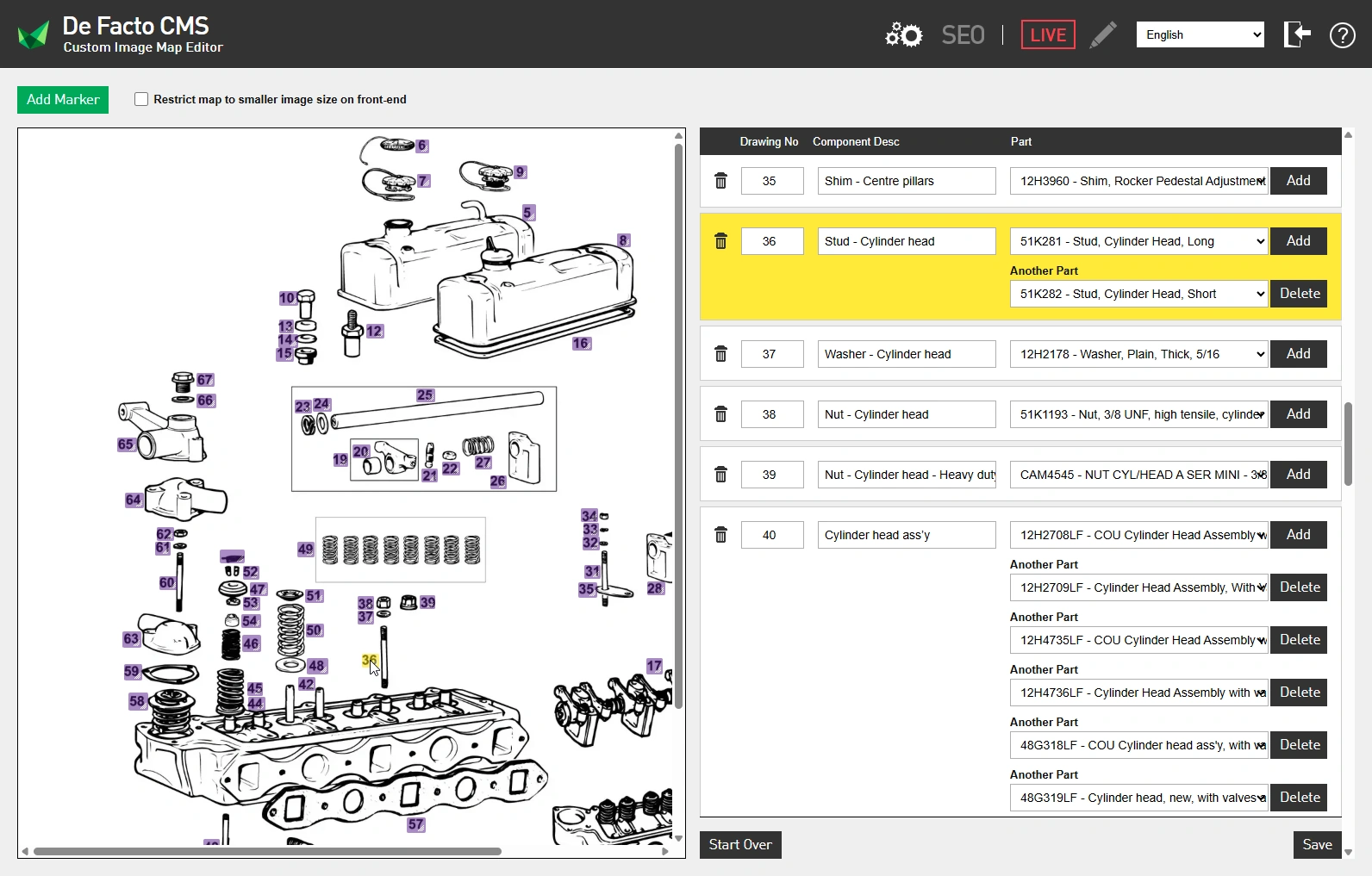
For example, for our customer MGOC Spares, we created interactive parts diagrams that allow customers to visually identify and select vehicle components. It's a simple, intuitive way to navigate thousands of specialist parts and demonstrates how the CMS can be extended to meet the unique requirements of each business.
Built Around Your Business, Not a Template
Every business manages information differently, so why should every website work the same way?
Unlike off-the-shelf e-commerce/CMS platforms that rely on predefined templates and structures, the De Facto CMS is designed around the unique e-commerce solution. The platform reflects how your business manages content, improves the way teams access and maintain information, and simplifies everyday website management - making it easier to work in a way that feels familiar rather than restrictive.
Role-based permissions also ensure every user only has access to the areas relevant to them, providing flexibility without compromising security.
Good Content Deserves to Be Found
Creating valuable content is only half the challenge - making sure people can find it is just as important.
The De Facto CMS includes built-in tools to help businesses manage their website's search engine optimisation (SEO), giving greater control over page titles, descriptions, URLs and other elements that influence how content is discovered online. Alongside this, content can be organised, categorised and scheduled in advance, making it easier to keep websites up to date and information easy to navigate.
Rather than treating SEO as a separate technical task, it becomes a natural part of the content publishing process.
A CMS That Continues to Evolve
A website shouldn't stand still, and neither should the management tools behind it.
The De Facto CMS continues to evolve through ongoing development, with new functionality shaped by customer feedback and changing business requirements. As organisations grow, websites expand and digital expectations change, the platform develops alongside them.
Ultimately, a CMS should do far more than help you update web pages. It should reduce reliance on developers, give your own teams greater independence, and create a website that actively supports marketing, collaboration and day-to-day business operations.
Explore how a connected website can become an extension of your business.
Explore Here